Speed and customer demands are constantly increasing. The family-run business Roth & Effinger is meeting these challenges with innovative drive, foresight and investment in digitalisation and automation.
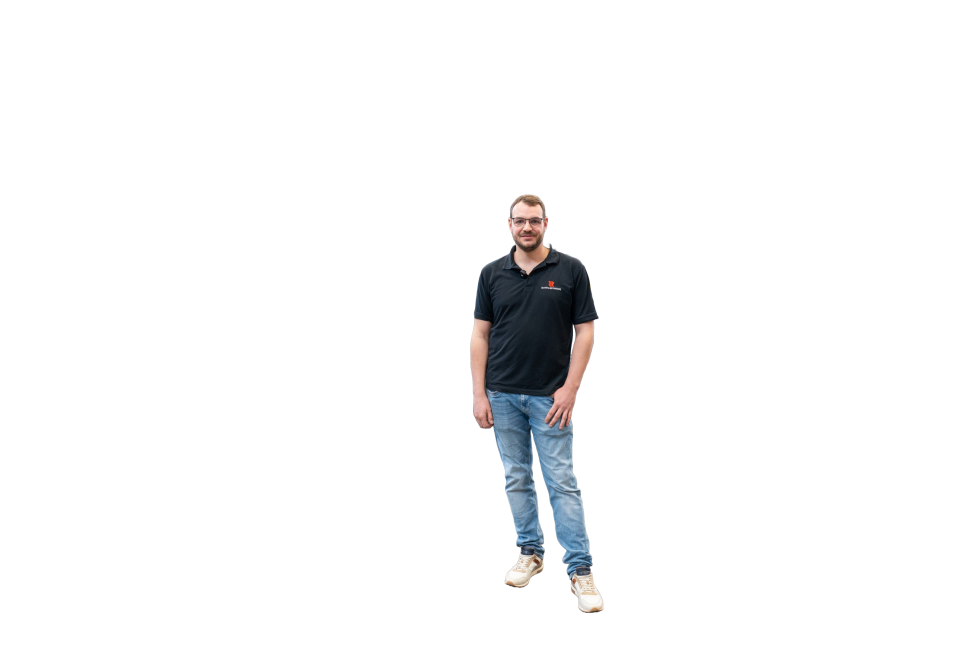
“I had my doubts as to whether the family business was the right fit for me,” recalls Marius Effinger. The 31-year-old has completed an apprenticeship as an industrial mechanic and a degree in mechanical engineering, and has known Roth & Effinger since his youth. His father is Gebhard Effinger, the long-standing managing director, and yet for a long time their professional interactions remained limited.
Marius Effinger wanted to pursue a career in the development and design of machine components and was convinced that the family business could not offer him the challenges he was seeking. He thought he would be underchallenged here – then suddenly the pandemic struck.
If you click on the application, a request with your IP address will be sent to an external provider.
The range of products is extremely wide, our vertical integration is high, and some of our customer orders are very complex.
A change of mindset during the crisis
Whilst Covid brought many businesses to a standstill, this was not the case at Roth & Effinger. So the young engineer began helping out at the family business. His father and his business partner Lars Roth – the son of the company’s founder – welcomed him with open arms. “I soon realised: I need to change my mind,” recalls Marius Effinger, once he had become more familiar with the business. “The range of products is extremely broad, our vertical integration is high, and some of the customer orders are very complex.” Marius Effinger cast his reservations aside and says today: “The challenges here are really enjoyable.”
Meanwhile, his younger son, David Effinger, is also working in the business. He is responsible for assembly, laser welding and various other operational tasks. With this reinforcement from the next generation, the company is ideally positioned for the future.
Co-Managing Director Gebhard Effinger, Project Coordinator Marius Effinger and Co-Managing Director Lars Roth.
Vertical integration is increasing
A glance inside the 3,000-square-metre production hall, with its modern and versatile machinery, reveals what opened Marius Effinger’s eyes. Around 40 specialists work here, processing a wide range of materials – from metals and plastics to rubber and organic materials such as wood. Despite this diversity, Roth & Effinger’s core competence lies in sheet metal and assembly production, and even here the scope is vast.
“We are currently manufacturing a stainless steel assembly for a client in Dubai, the level of vertical integration of which surpasses anything we have done before,” says Marius Effinger. The module is used in water treatment and consists of three round elements welded together, which are aligned with millimetre precision: a core coated with a permanent magnet, a casing and a mounting bracket. Several machining processes are employed, and the tolerances are exceptionally tight – the level of complexity involved in this particular order is extremely high.
Another flagship project for Roth & Effinger is the manufacture of assemblies and components. Right by the entrance hangs a blueprint of a record-breaking oven: a deck-type oven measuring 17.6 metres in length, 3 metres in width and 4.6 metres in height at the burner section, which is being manufactured for a client in the bakery sector. This project, too, highlights the wide range of skills that need to work together: welding, bending/folding/forming, mechanical and CNC machining, and, of course, our speciality: laser cutting.
New laser boosts production speed
“We’ve always been strong in laser cutting,” says Gebhard Effinger, and Lars Roth adds: “We’ve always been able to produce large quantities in a short space of time.” They are referring, for example, to the 20,000 to 30,000 sheets per year, 6.75 millimetres thick, for a local agricultural machinery manufacturer. “Today, such production runs can be handled even more efficiently and cost-effectively.”
One reason for the increase in speed and a further improvement in precision during laser cutting is the purchase in 2025 of a ByCut 3015 fibre laser, complete with the ByLoader Flex automatic loading and unloading solution. With this new acquisition, the family-run business now has a total of three Bystronic fibre lasers with power ratings of 6 kW, 8 kW and 10 kW.
Innovation in their DNA
When it comes to laser cutting, Roth & Effinger is a name you simply cannot ignore in the region. But that’s not all: “The company is in a league of its own in many areas – particularly when it comes to innovation,” explains Bystronic sales representative Bernhard Eid. They have been working together for many years and are able to benefit from one another in their efforts to further develop sheet metal processing.
What Bernhard Eid means when he talks about innovative strength is evident, for example, in the handling of raw materials. “We used to pick the material up off the floor during laser cutting – that was a faff,” says Marius Effinger. To improve the workflow, two height-adjustable tables were designed in-house: On one table, the raw material is stacked for loading onto the ByCut 3015 via the Flexloader. On the other, the cut flat sheets are placed, separated and sorted. “The two tables optimise accessibility and ergonomics for the operators. And more parts can be stockpiled, which is handy for night shifts.”
High-bay warehouse for 1,000 tonnes of raw materials
Roth & Effinger also ensures that sufficient raw materials are available at all times. All metal sheets are stored in the high-bay warehouse: the four racking towers are each 17 metres high, offer space for 314 pallets – and are fully automated. The total capacity is almost 1,000 tonnes of raw materials.
“What you’ve got, you’ve got,” says Marius Effinger coolly, in his typically matter-of-fact manner. “The stock simplifies our workflow and provides planning certainty.” Given the uncertainties in supply chains, it is crucial to have raw materials available at all times in order to fulfil framework contracts on time and at the agreed price.
Security of supply also plays a key role when it comes to the cutting gas used for laser cutting. That is why, since spring 2026, a 14-metre-high gas tank has stood outside Gate 3, with a capacity of 24,000 cubic metres of nitrogen. “Thanks to this storage capacity, gas deliveries have been drastically reduced and, during shift work, the gas supply is guaranteed at all times,” says Marius Effinger.
Gradually reducing manual labour
Shift and night-shift operations have also become an issue because the speed of laser cutting is constantly increasing. However, the subsequent processes – bending, milling and welding – still involve a great deal of manual labour. The planned investment in a Bystronic Mobile Bending Cell with automation therefore marks the next step towards unmanned production.
The bending automation is expected to significantly speed up workflows, but according to Marius Effinger, it is also a question of the optimal allocation of resources. “If a skilled worker is running in prototypes or bending special parts instead of spending 35 hours at the press brake working on a production part, that brings us significantly more benefit overall.” After all, vertical integration is constantly increasing, and a high degree of flexibility has always been part of the company’s philosophy: “We don’t just want mass production. Individual parts and prototypes are the batch sizes that make us crisis-proof,” explains Marius Effinger.
In-house design services now available
Founded in 1987, the company has grown steadily despite economic crises – thanks to the continuous development of in-house expertise. It now also offers design services: from new designs to the optimisation of existing solutions, always with a focus on cost-effective and efficient manufacturing.
The new design offering is a response to rising demand from local customers. “Small design changes can often make a part significantly cheaper,” explains Marius Effinger. “A bore with too tight a tolerance can increase costs by up to 20 per cent.” That is why close consultation with customers regarding the tolerance range is crucial.
Top priority: flexibility
Roth & Effinger’s strong customer focus is evident almost every day. Often, things need to be done quickly – for example, because a customer’s machinery has come to a standstill. “If a customer urgently needs a part, we reorganise production and re-prioritise the day’s tasks,” says business owner Lars Roth.
New orders come in by telephone or via digital channels: customers can submit their CAD drawings by email or via the B2B webshop and place orders specifying quantities and delivery dates. In addition to flat parts and bent parts, services such as deburring and powder coating are also available via digital channels.
If a rush order comes in, it is recorded directly in the ERP system and the daily schedule is adjusted in real time. All screens in the workshop immediately display the updated order list. At the same time as the order is recorded, each part is assigned a company part number. “This ensures that every part is tracked throughout the entire process,” says Marius Effinger. This traceability is not only practical but also central to quality assurance.
Small design changes can often make a part significantly cheaper.
Further expanding digitalisation
In the near future, the company plans to make even greater use of digital opportunities. A new ERP system is in the pipeline: “We aim to further optimise order entry and processing and to integrate the high-bay warehouse,” says Marius Effinger, looking ahead. Raw material recording needs to be implemented even more consistently – to enable better planning of procurement.
As a company with experience of growth, the management team comprising Lars Roth, Gebhard Effinger and Marius Effinger knows that every expansion – and therefore every investment – must be backed by customer orders. The trio are in agreement: “We are proceeding step by step and, as it were, evolving alongside the local market.” With this approach, Roth & Effinger has grown from seven to forty employees in just under 40 years – and has become an indispensable part of the Brigachtal industrial landscape.
The municipality of Brigachtal is typical of many towns in the southern German federal state of Baden-Württemberg: idyllically situated amidst unspoilt nature, with a vibrant community life and economic success fuelled by a strong entrepreneurial spirit. Around 5,200 people live in the municipality, whose motto is: ‘Live a more attractive life’.
Baden-Württemberg ranks among Europe’s leading economic regions. The state is characterised by well-known global corporations in the automotive, electrical engineering and mechanical engineering sectors, as well as numerous significant family-run businesses. This interplay between large companies and a strong SME sector ensures economic attractiveness and prosperity.